21.3 New Company
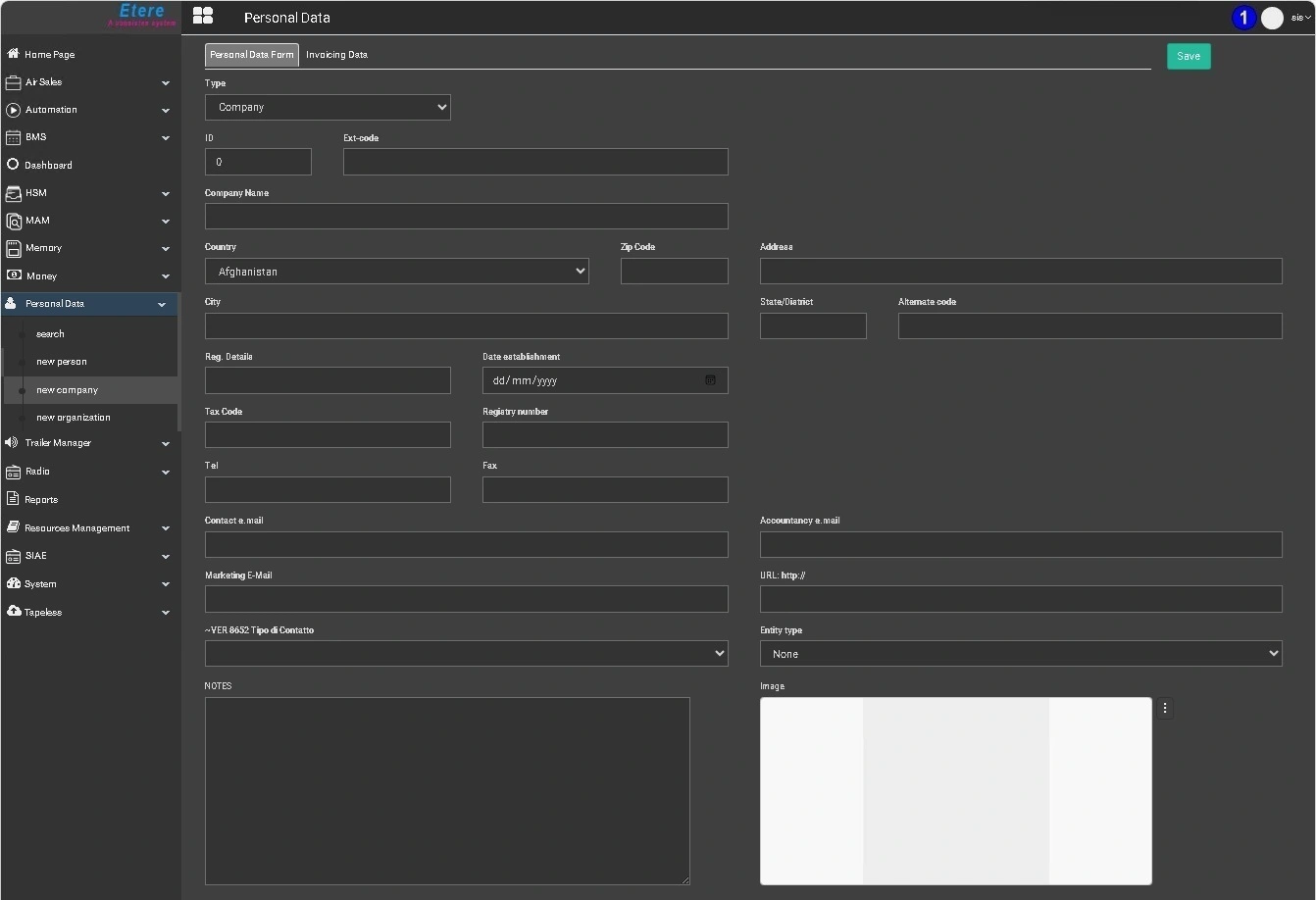
The New Company page allows you to create a new company contact by entering the relevant information and saving the record using the Save button located at the top of the page.
When creating a new company, the following fields are available within the Personal Data Form tab:
Type: Predefined as Company and not editable.
ID: A unique identifier automatically assigned by the system and not editable.
Ext-Code: A user-defined, editable identifier that can be used alongside the system-generated ID to quickly recognize a contact.
Company Name: The official legal name of the company, used to uniquely identify the entity within the system and in all related business, administrative, and financial processes.
Country: Selectable from a drop-down list.
ZIP Code: Postal code.
Address: Street address.
City: The city in which the company is located.
State/District: State or regional information.
Alternate Code: An additional identification field that can be used for internal or external reference codes, depending on operational needs.
Reg. Details: Additional registration information related to the company, intended to complement the registry number by providing further official or administrative details associated with the entity’s registration.
Date of Establishment: The date on which the company was officially formed or legally registered.
Tax Code: The personal tax identification number (e.g. fiscal code), where applicable.
Registry Number: A general-purpose registration or identification number, typically used to store official or administrative references when required.
Tel: Telephone number.
Fax: Fax number.
Contact E-mail: General-purpose email address used for standard communications with the company.
Accountancy E-mail: Email address dedicated to financial and accounting communications, such as invoicing and payment-related matters.
Marketing E-mail: Email address used for marketing and promotional communications.
URL: http://: The company’s website address, used to access its online presence.
Contact Type: A configurable field intended to classify the contact according to predefined categories; available options depend on system configuration.
Entity Type: Allows classification of the company within specific business roles, such as Account Executive, Agency, Media Center, or Purchasing Group.
Notes: Free-text field for additional information.
A dedicated panel is available for uploading a profile image. To add an image, click the [ ⋮ ] button, select Load Image, and choose the desired file. To remove an existing image, use the same menu and select Delete Image.
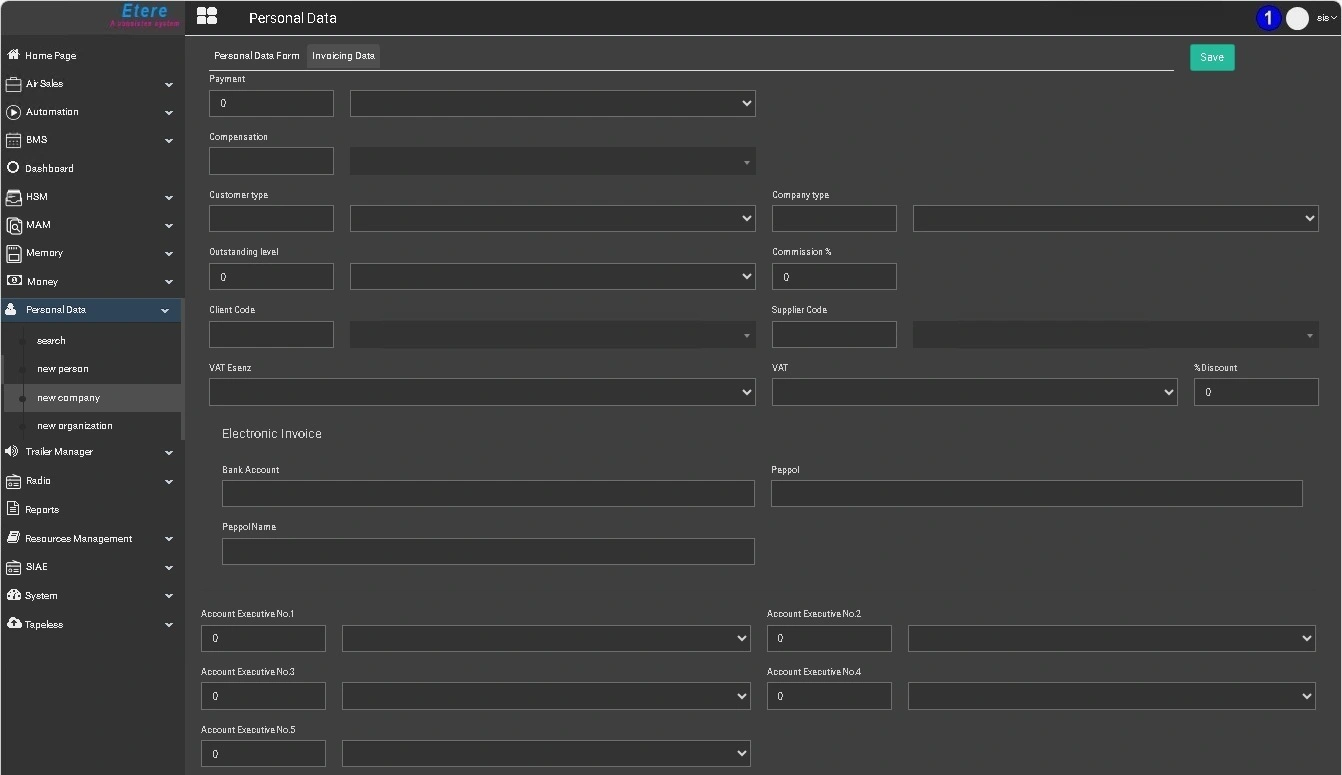
The following fields are instead available within the Invoicing Data tab when creating a new company:
Payment: Defines the payment method associated with the company. The field consists of a code and a corresponding description and it's selectable from a drop-down list within the description field.
Compensation: Indicates whether financial compensation or offsetting mechanisms are applied to the company’s transactions, typically used to balance receivables and payables.
Customer Type: Classifies the company according to its role as a customer, based on predefined categories used for commercial or reporting purposes.
Company Type: Defines the general classification of the company within the system, according to configured categories.
Outstanding Level: Represents the level of outstanding credit or exposure associated with the company, used for financial control and risk assessment.
Commission: Percentage value representing the commission applied to transactions involving the company.
Client Code: Internal code used to identify the company as a customer within accounting or commercial processes.
Supplier Code: Internal code used to identify the company as a supplier within purchasing or accounting processes.
VAT Esenz: Indicates whether the company is exempt from VAT and under which conditions.
VAT: Specifies the VAT rate applicable to transactions involving the company.
Discount: Default discount percentage applied to the company during commercial transactions.
Within the Electronic Invoice section, you can define the following information:
Bank Account: Bank account details associated with the company for invoicing and payment purposes.
PEPPOL: Identifier used within the PEPPOL (Pan-European Public Procurement On-Line) network, an international standard for the exchange of electronic invoices and procurement documents.
PEPPOL Name: The registered name of the company within the PEPPOL network, used to identify the recipient in electronic document exchanges.
Account Executive No. 1 / 2 / 3 / 4 / 5: Fields that allow the assignment of one or more account executives to the company. Each field can be populated by selecting a contact from a predefined list, enabling the association of responsible personnel for commercial management and client relations.
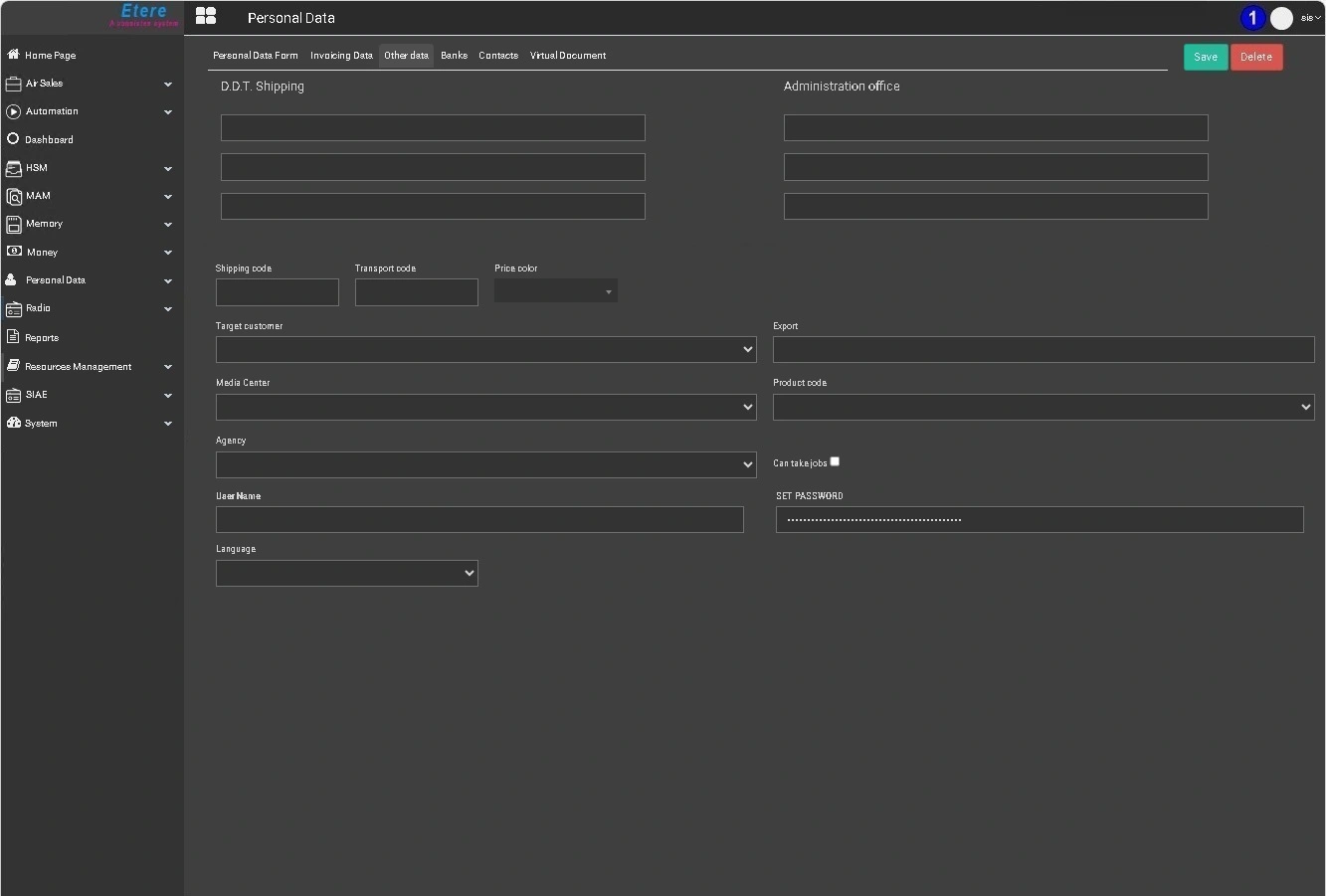
Once the new company record has been created, additional tabs become available, namely Other Data, Contacts, Banks and Virtual Document. At the same time, a Delete button is displayed next to the Save button at the top of the page.
Within the Other Data tab, it is possible to define the following information:
D.D.T. Shipping: Shipping and delivery details associated with the transport of goods, corresponding to the information typically included in a delivery document
Administration office: Administrative address and contact details associated with the company’s administrative functions, typically used for official communications, billing, and accounting purposes
Shipping Code: Free-text field used to store a shipping-related reference code associated with the company. It can be used for internal or external identification purposes within logistics or delivery workflows.
Transport Code: Free-text field used to define a transport-related reference code, typically associated with logistics processes or transport providers.
Price Color: Defines the default price list classification applied to the company in sales proposals and orders, determining which pricing scheme is used in commercial transactions
Target Customer: Identifies the reference customer entity to which the company is associated, typically used for grouping or commercial relationship purposes.
Export: Specifies a reference value used during data export procedures , indicating the target system or context in which the data will be processed.
Media Center: Defines the media center entity associated with the company, used to establish relationships within media planning or advertising workflows.
Product Code: Defines the default product category associated with the contact, based on a predefined classification system
Agency: Identifies the agency linked to the company, enabling structured relationships between clients, intermediaries, and other involved parties.
Within this tab, it is also possible to define login credentials (in the User Name and SET PASSWORD fields) associated with the company. This enables an authorized representative of the company to access EtereWeb using the specified credentials and perform controlled and authorized tasks and activities within the system, such as uploading requested documents or providing operational inputs, depending on the assigned permissions.
The Can take jobs option allows the company to be assigned tasks by other users. When enabled, the company becomes eligible for job assignment within operational workflows.
A language selection drop-down menu is also available, allowing you to define the interface language of EtereWeb (and Etere x64 applications such as Nunzio Player, Master Control Panel, Studio Player and others) for that specific user. This setting is particularly useful in multinational environments, where users may require the system to be displayed in different languages based on their location or preferences.
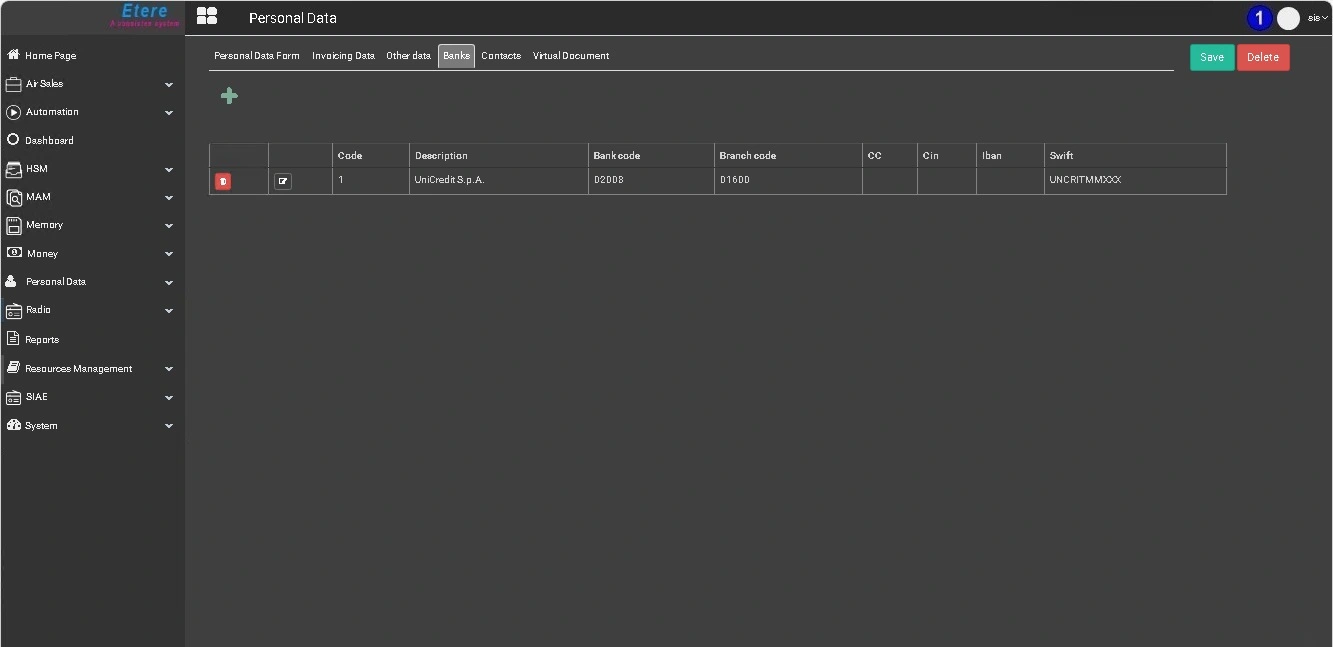
The Banks tab allows you to associate one or more bank accounts with the selected company.
Adding a bank
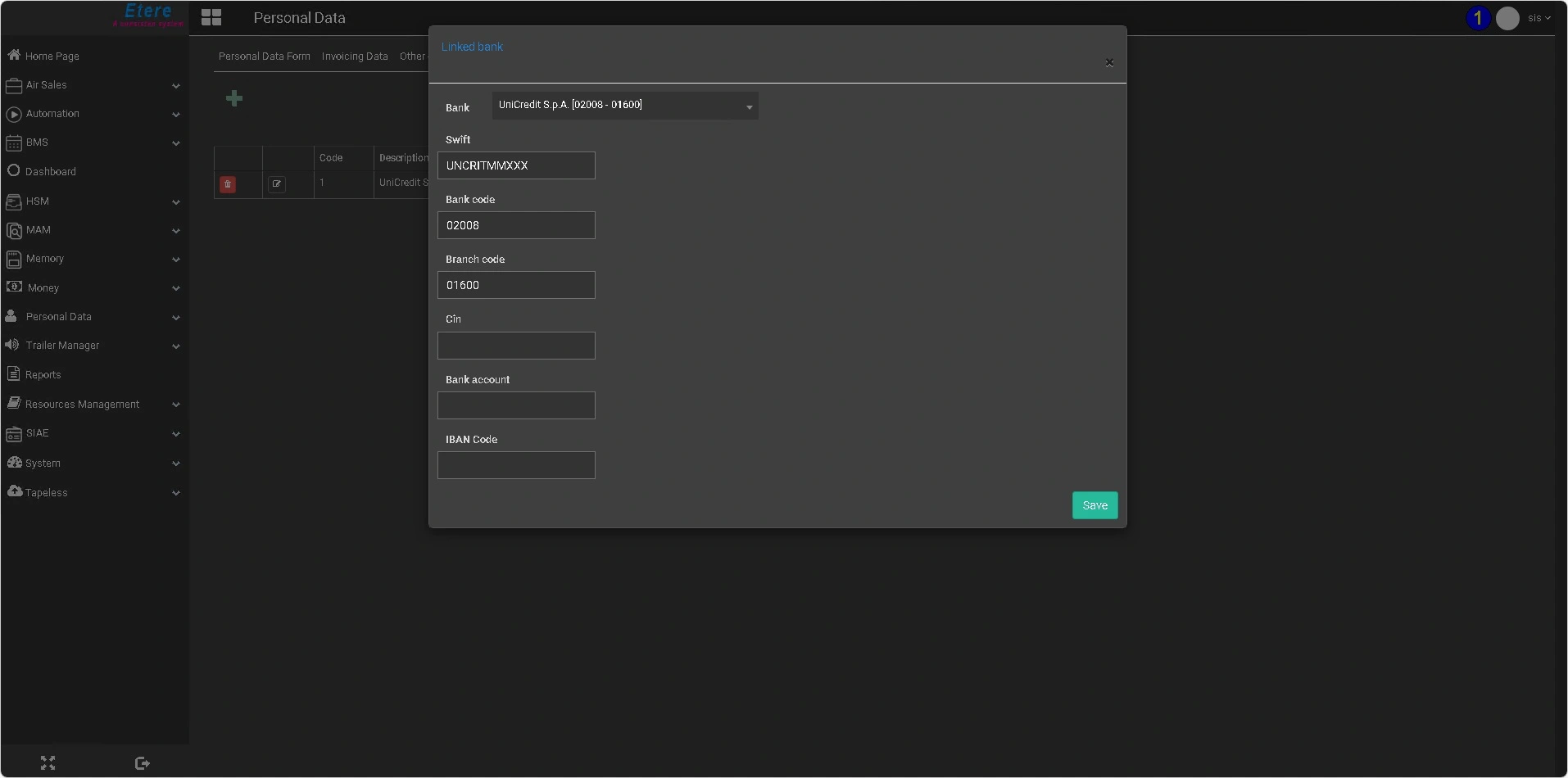
To associate a bank, click the “+” button. This opens the Linked Bank form, where you can select a bank from the drop-down list of those already available in the database.
Once selected, the system automatically populates the Swift, Bank code and Branch code fields..
The CIN, Bank Account, and IBAN fields must be instead entered manually.
Managing associated banks
Below the “+” button, all linked banks are displayed in a table with the following columns:
Remove: Deletes the association between the bank and the company
Edit: Opens the Linked Bank form to modify editable fields
Description: Bank name
Bank Code: Bank identifier
Branch Code: Branch identifier
CC: Company’s bank account number
CIN: Control code used in national banking systems
IBAN: International bank account identifier
SWIFT: International bank identifier code
This structure allows you to manage multiple banking relationships for the same company in a centralized and organized way.
The Contacts tab allows you to associate one or more contacts of type Person with the selected company.
Adding a contact
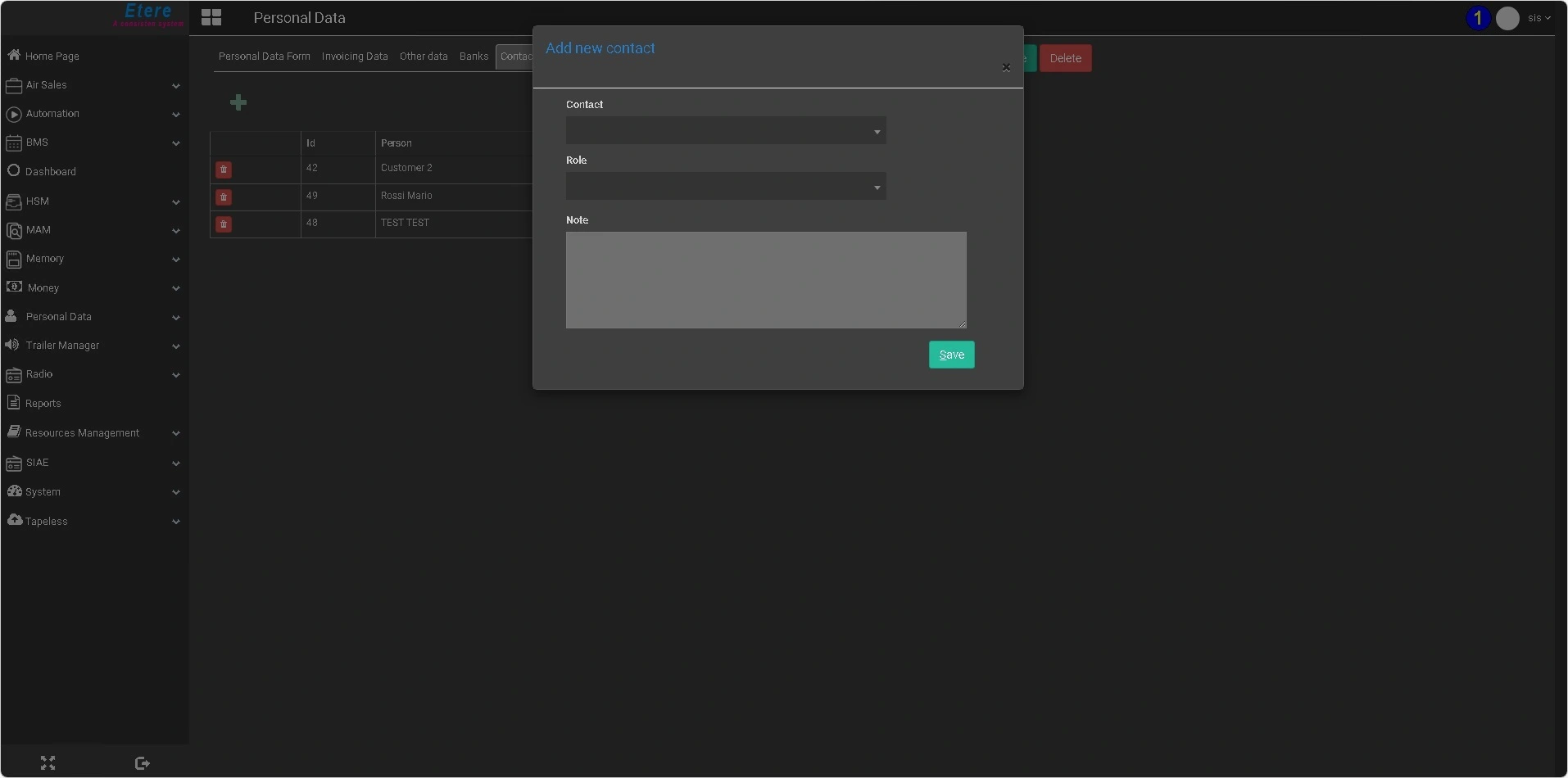
To add a new contact, click the “+” button. This opens the Add New Contact form, where you can:
Select a Contact of type Person from the available drop-down list
Assign a Role using the corresponding drop-down menu
Enter optional notes in the Note field
Note: The Role field is mandatory. If no role is selected, the contact cannot be saved and an error message (“Missing data for new contact”) is displayed.
Managing associated contacts
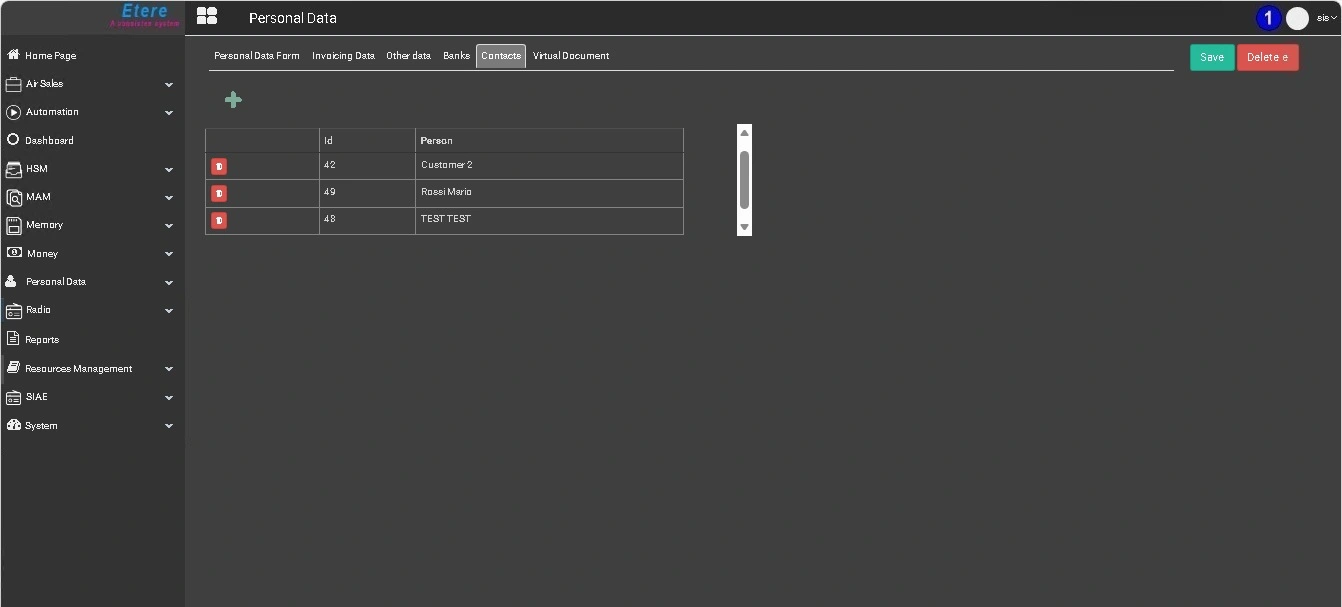
Below the “+” button, all linked contacts are displayed in a table with the following columns:
Remove: Deletes the association between the company and the contact
Id: Unique identifier of the person
Person: Full name (surname and name) of the contact
This section allows you to maintain a structured list of individuals associated with the company and their respective roles.
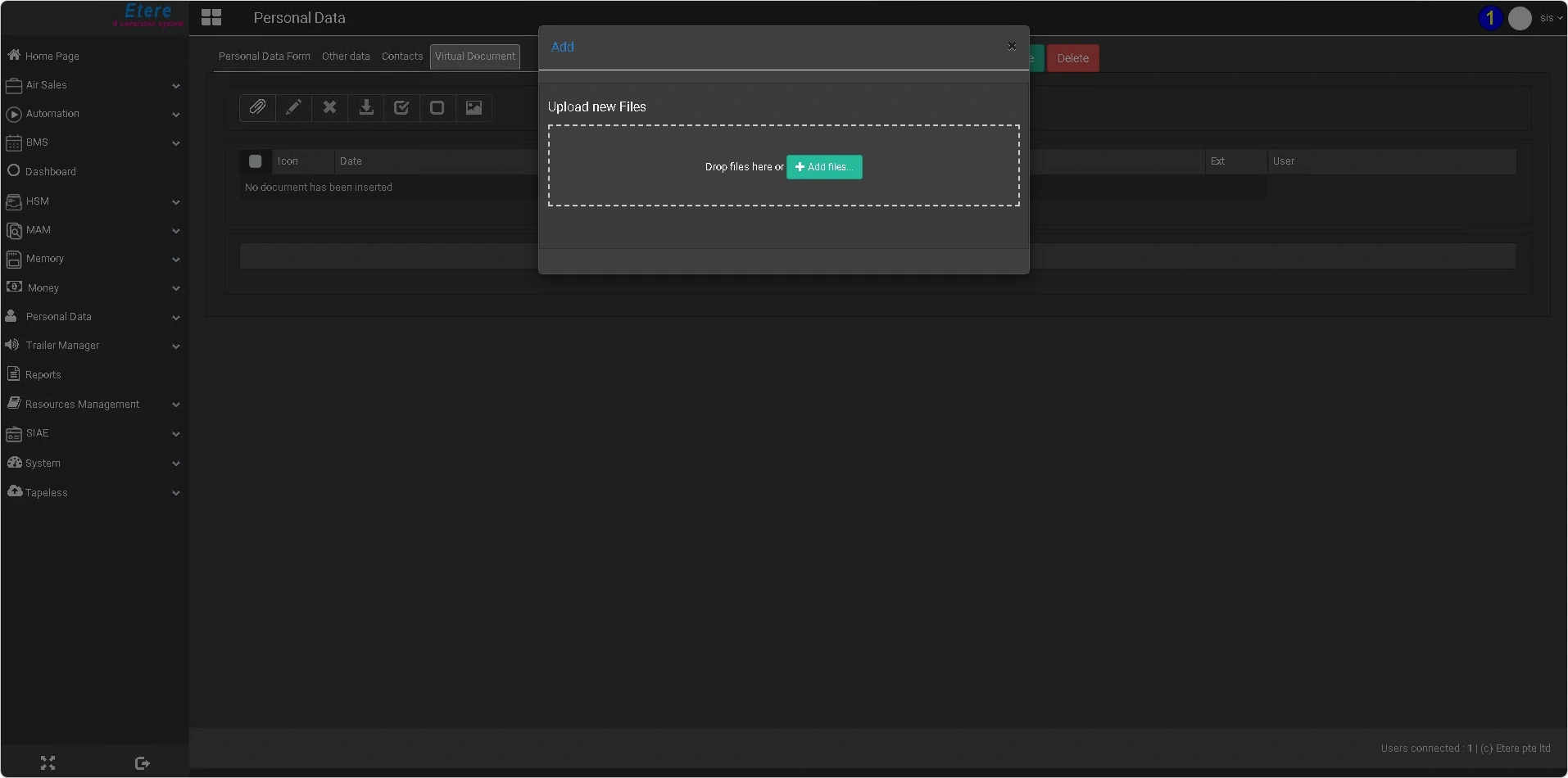
The Virtual Document tab allows you to upload and associate documents with the selected company. Each uploaded file becomes part of the contact’s record and can be managed directly from this section.
Available actions
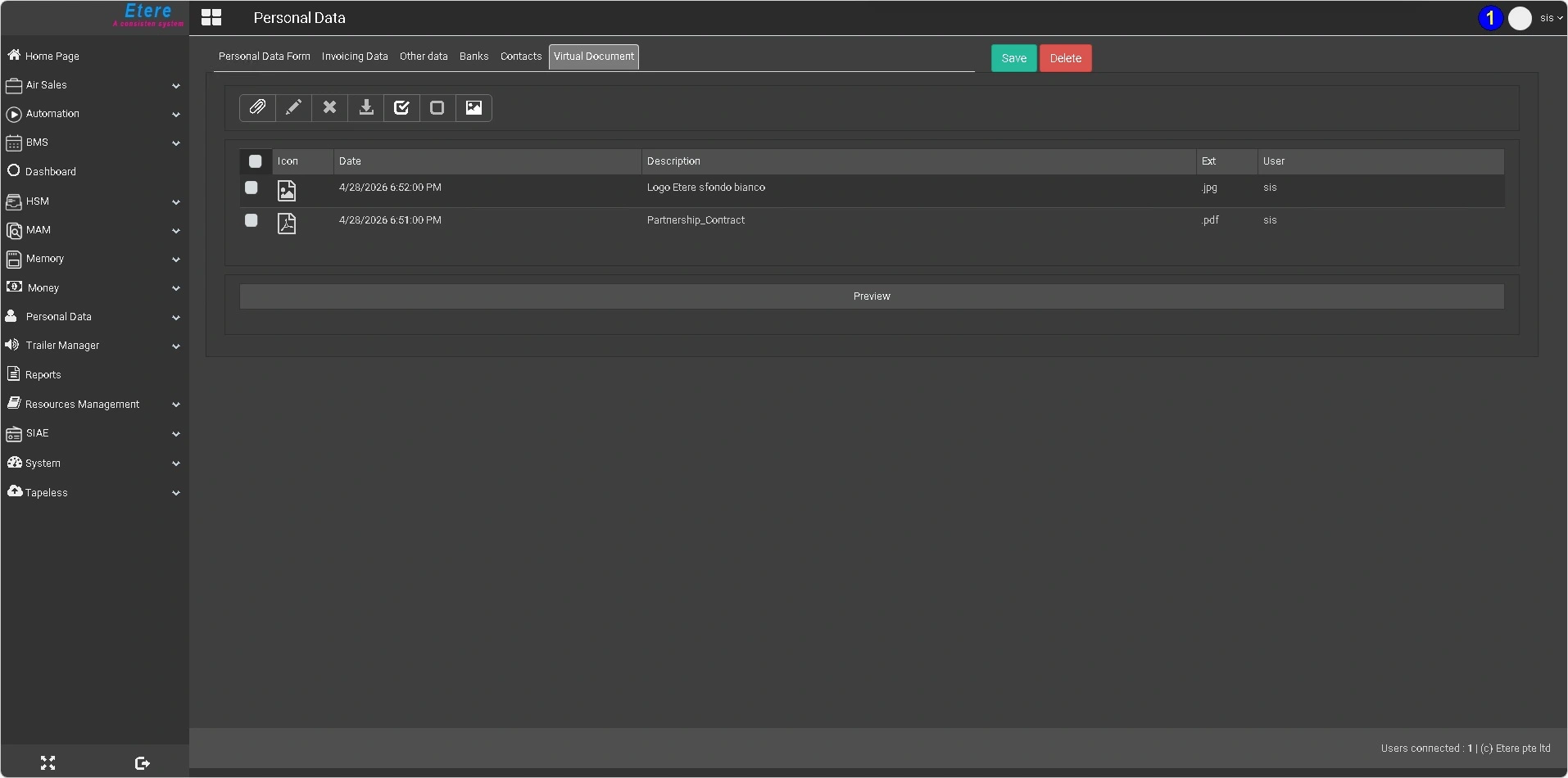
The toolbar at the top of the page provides the following functions:
Add: Upload and associate a new document with the contact.
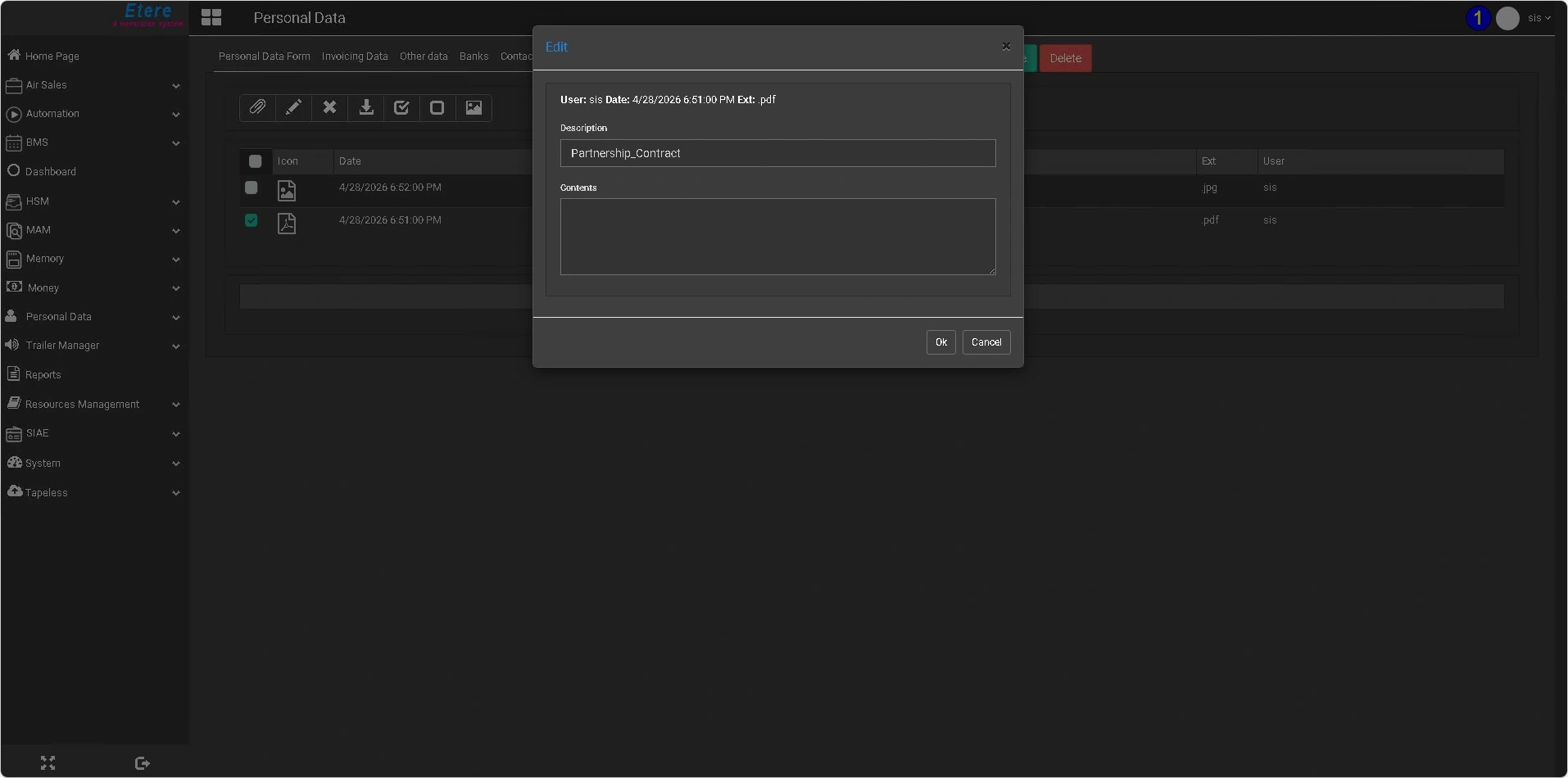
Edit: Modify the Contents field of the selected document, typically used to add notes, descriptions, or contextual information.
Delete: Remove the selected document from the contact’s record.
Download: Download the selected document locally.
Select All / Deselect All: Select or clear the selection of all listed documents.
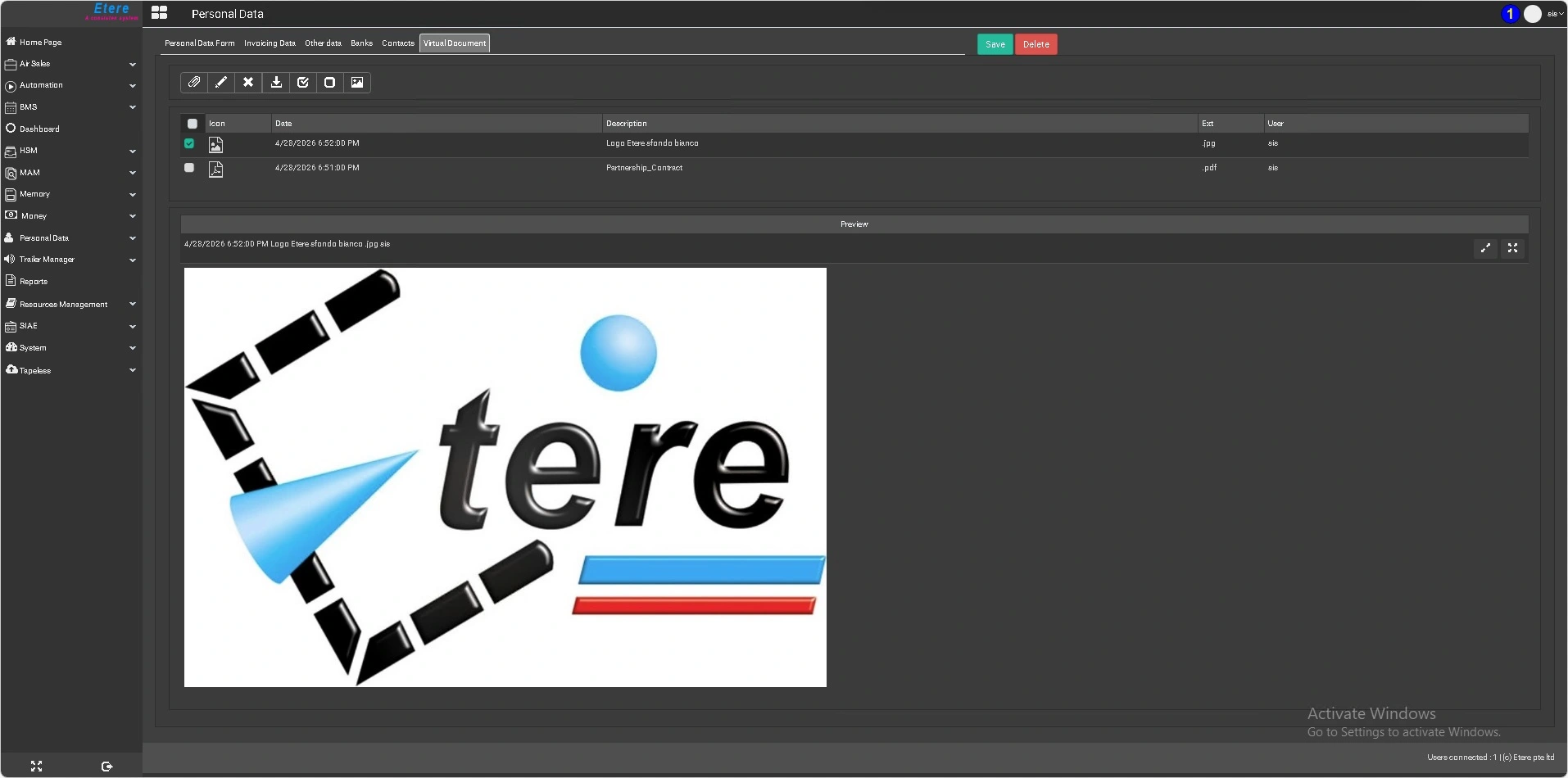
Preview: Display a preview of the selected document in the dedicated section.
Note: The Edit, Delete and Download functions can be used only when at least one document is selected using the corresponding checkbox. Multiple documents can be selected, allowing these actions to be applied to more than one item at the same time (where applicable). The Preview function behaves as a toggle: it can be activated before or after selecting a document, and the preview will be displayed once a document is selected.
Document list
Below the toolbar, all uploaded documents are displayed in a table with the following columns:
Selection checkbox: Allows selection of one or more documents
Icon: Indicates the file type (e.g. PDF, image, video)
Date: The date on which the document was uploaded
Description: The name or title of the uploaded document
Ext: The file extension
User: The user who uploaded the document
Preview section
At the bottom of the page, the Preview section displays the content of the selected document/s when the Preview function is used
 etereweb_personaldata_newcompany_personaldataform
 etereweb_personaldata_newcompany_invoicingdata
 etereweb_personaldata_company_otherdata
 etereweb_personaldata_company_banks
 etereweb_personaldata_company_banks_linkedbank
 etereweb_personaldata_company_contacts
 etereweb_personaldata_company_contacts_addnewcontact
 etereweb_personaldata_company_virtualdocument
 etereweb_personaldata_company_virtualdocument_add
 etereweb_personaldata_company_virtualdocument_edit
 etereweb_personaldata_company_virtualdocument_preview